Figure Skating Spin Levels Explained: Why Level 4 Isn’t Everything

12 min read
Contents
- First, Identify the Spin Position
- Upright, Sit and Camel Spins
- Flying Spins and Combination Spins
- What Actually Makes a Spin More Difficult?
- Difficult Positions, Changes of Edge and Speed
- Why Level 4 Requires More Than Four Visible Tricks
- Spin Level Versus Grade of Execution
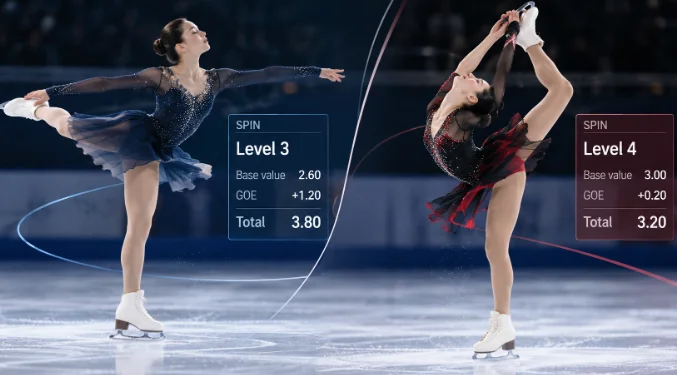
- Can a Level 3 Spin Outscore a Level 4 Spin?
- What About Choreographic Spins?
- How to Watch a Spin Without Counting Every Revolution
- Common Reasons a Spin Scores Less Than Expected
A skater settles into a fast, beautifully centred spin, changes position without losing speed and finishes exactly on the music. The scoreboard calls it Level 3. A few minutes later, another skater performs a more complicated-looking spin, earns Level 4, but receives fewer points for the element. How can that happen?
Figure skating spins are evaluated in two separate ways: the technical panel determines their level of difficulty, while the judges assess the quality of execution. Understanding that distinction—and the changes introduced for the 2026/27 season—makes spins considerably more interesting to watch.
First, Identify the Spin Position
Before trying to determine a spin’s level, identify what kind of spin the skater is performing. The International Skating Union (ISU) recognises three basic spin positions: upright, sit and camel. Each has variations that can change the spin’s appearance and technical difficulty.
The position tells you what the element is. Its level tells you how many eligible difficulty features the technical panel recognised. A basic camel spin and a Level 4 camel spin belong to the same family, but the latter meets additional requirements.
Upright, Sit and Camel Spins
Upright spins keep the skating leg straight or slightly bent, with the body generally more vertical than in the other basic positions. The familiar scratch spin belongs to this family, as do layback and Biellmann variations. A Biellmann, with the free skate pulled high above the head, can be spectacular, but the position alone does not automatically establish a particular level.
Sit spins require the upper part of the skating leg to be at least parallel to the ice. The skater lowers into a deeply bent supporting knee while maintaining rotation. Variations include positions where the free leg stretches forward, crosses over the supporting leg or is held close to the body.
Camel spins feature the free leg extended backward, with its knee at or above hip level. From the side, the skater often resembles a horizontal line balanced on one blade. Difficult variations can alter the torso, arms or free-leg position while preserving the required characteristics.
These definitions matter because a position that looks close enough from the stands may not fully satisfy the technical requirements. An insufficiently low sit spin or a camel position with a dropping free leg can affect the element’s identification, credited features or execution marks.
Flying Spins and Combination Spins
A flying spin begins with a jump into the spinning position. In a flying camel, for example, the skater leaves the ice and lands into a camel spin. The jump must be clearly visible for the element to meet the applicable flying-spin requirements.
A combination spin includes changes between basic positions, such as camel, sit and upright. Some combinations also change feet. A spin that changes feet is not necessarily a flying spin; the skater can switch from one skating foot to the other without jumping.
On a judging sheet, CCoSp4 identifies a Level 4 combination spin with a change of foot. The final number is the awarded level, not the number of rotations performed.
This is a useful distinction to remember when watching a long combination: a skater can perform many revolutions without automatically earning Level 4.
What Actually Makes a Spin More Difficult?
Under the ISU’s 2026/27 system, a spin normally needs one recognised difficulty feature for Level 1, two for Level 2, three for Level 3 and four for Level 4. A spin meeting the minimum requirements but receiving no credited level features can be assigned Base Level, shown as B.
There are additional restrictions, particularly for Level 4. The technical panel must confirm that each feature was performed correctly and is eligible to count.
| Spin level | Credited features | CCoSp base value, 2026/27 |
|---|---|---|
| Base (B) | No level features credited | 2.00 |
| Level 1 | 1 | 2.40 |
| Level 2 | 2 | 3.00 |
| Level 3 | 3 | 3.60 |
| Level 4 | 4, including a qualifying Level 4 feature | 4.20 |
These values apply to a combination spin with change of foot meeting the requirements for its standard base value. Other spin types have different values, and reduced-value calls can apply when requirements are not satisfied.
Difficult Positions, Changes of Edge and Speed
A difficult variation changes the position in a way that significantly affects balance, strength, flexibility or control. The feature must meet the ISU’s technical definition; simply raising an arm or making a position look unusual is not enough.
Other recognised features include a qualifying change of edge, a difficult entrance or exit, a jump within a spin, a clear increase in rotational speed, and sustained revolutions in specified positions.
A change of edge is particularly subtle. The skater moves from one edge of the blade to another while maintaining the spin, with the permitted direction of the change depending on the position. A slight wobble or shift across the blade does not necessarily qualify.
Speed can also contribute to difficulty, but it must be a clear increase in an eligible position. Starting fast and gradually slowing down does not count as acceleration.
For spectators, these details explain why one apparently simple spin may earn a higher level than a visually elaborate one. The technical panel evaluates recognised features rather than counting every visible movement.
Why Level 4 Requires More Than Four Visible Tricks
The 2026/27 rules tightened the qualifications for Level 4. In addition to four credited features, at least one must come from a specific group identified by the ISU:
- A difficult exit.
- A qualifying clear change of edge.
- Rotation in both directions immediately following each other in an eligible position.
- A clear increase in speed.
- A difficult variation of a flying entry.
- Three consecutive qualifying windmill movements.
One notable change is that a difficult change of position on the same foot can still count as a regular feature, but no longer satisfies the additional Level 4 condition by itself.
Windmills were introduced as a distinct feature for 2026/27. The skater must complete three consecutive movements, each reaching close to a split position of at least 135 degrees. One isolated illusion-style movement is not sufficient.
There are restrictions on repeating features. Most specified features count only once per program, and no more than two difficult variations can contribute level features within one spin. In a change-foot spin, no more than two features can be credited on either foot.
Consider a skater who visibly performs several difficult variations but repeats one already used in an earlier spin. The repeated variation may not provide another credited feature. If the spin then lacks the additional qualifying requirement, Level 4 remains out of reach despite its complexity.
The lesson for viewers is simple: Level 4 is not awarded for looking difficult. It is awarded for completing a specific combination of recognised requirements.
Spin Level Versus Grade of Execution
A spin’s level establishes its base value. Grade of Execution (GOE) determines how much is added or subtracted for the quality of performance. The two are assessed separately.
The technical panel identifies the spin and its features. Judges then evaluate qualities such as speed, acceleration, centred rotation, clear positions, effortless execution, creativity and how well the element fits the music.
GOE grades range from −5 to +5. They are converted into numerical adjustments using the current Scale of Values and combined according to the judging system.
A Level 4 spin can therefore receive negative GOE if it travels across the ice, loses speed, contains weak positions or finishes awkwardly. A Level 3 spin performed with excellent control can receive strongly positive GOE.
Can a Level 3 Spin Outscore a Level 4 Spin?
Yes. The 2026/27 Scale of Values provides a clear example using combination spins with a change of foot.
Suppose Skater A performs a CCoSp3, worth 3.60 points before GOE. The spin is fast, well centred and controlled throughout. If the final panel GOE corresponds to +4, the numerical adjustment is +1.44.
Skater A: 3.60 + 1.44 = 5.04 points.
Skater B earns CCoSp4, worth 4.20 points before GOE, but struggles with speed and control. If the final panel GOE corresponds to −1, the adjustment is −0.42.
Skater B: 4.20 − 0.42 = 3.78 points.
These are hypothetical examples using official 2026/27 base values and GOE increments, not results from an actual competition.
Despite performing the higher-level spin, Skater B receives 1.26 fewer points. The example does not mean Level 3 is preferable: equally well-executed Level 4 spins have a higher scoring potential. It shows why gaining a feature is only valuable when the skater can maintain sufficient execution quality.
For a coach, that creates a practical trade-off between adding difficulty and preserving control. For a viewer, it explains why a beautifully performed spin may be more valuable than one packed with visibly demanding positions.
What About Choreographic Spins?
The choreographic spin is a significant addition to single skating in the 2026/27 season. In junior and senior free skating, one previously required levelled spin has been replaced by a choreographic spin.
Unlike a conventional spin, the ChSp1 does not receive levels from Base through Level 4. It has a fixed base value of 3.50 points, and the judges’ GOE determines its final value.
The ISU defines the choreographic spin as an element that enhances the choreography and matches the music. It requires at least three consecutive revolutions, with basic or non-basic positions permitted. Changes of foot are optional. The technical panel confirms the element when the applicable requirements are met.
Judges consider musical connection, creativity, effortless execution, controlled positions and intentional variations of speed. The spin should feel like part of the performance rather than a technical exercise inserted between jumps.
This changes what spectators should look for during a free skate. A choreographic spin may appear less mechanically complicated than a Level 4 combination, yet receive excellent GOE because its movement and timing complement the music.
Skate Canada’s published 2026/27 Podium Pathway changes confirm the replacement for junior and senior singles. Domestic requirements still vary by category: novice free programs now have two spins, while the juvenile category has its own restrictions, including a maximum Level 1 for the designated combination spin under specified conditions.
Older competition videos and score sheets therefore need to be interpreted against the rules of their season. A 2025/26 junior free skate and a 2026/27 junior free skate do not have identical required spin layouts.
How to Watch a Spin Without Counting Every Revolution
You can learn a surprising amount about a spin by following its shape and movement rather than trying to count every turn at full speed.
Start with the entry. Does the skater glide directly into the spin, or is there a clearly visible flying entry? Then watch what happens once rotation begins.
- Identify the basic position. Look for upright, sit or camel characteristics before paying attention to difficult variations.
- Check the centre. A well-centred spin remains in a relatively small area of ice. Travelling across the surface can indicate a loss of control.
- Notice changes. Watch for changes of foot, edge, direction or position. These may be level features, although not every visible change qualifies.
- Follow the speed. Does the skater maintain rotation, accelerate or visibly slow down? Consider whether a change appears intentional.
- Watch the exit. A controlled finish that fits the music can strengthen the overall impression, while an awkward recovery may reduce GOE.
Recognising spin positions is one part of learning to watch the full program with a clearer eye for technical details, especially when jumps and step sequences compete for your attention.
If you want to practise, choose one skater and watch the same spin twice. On the first viewing, identify its family and overall quality. On the second, look for possible level features. Compare your observations with the published judging protocol rather than assuming that every variation you noticed received credit.
Common Reasons a Spin Scores Less Than Expected
Sometimes the problem is obvious: a skater loses balance, slows dramatically or struggles to exit. Other times, the spin looks entirely respectable but receives a lower technical level than expected.
A frequent cause is a feature that was attempted but not sufficiently established. The technical panel may decide that a difficult position was unclear, the required revolutions were not completed or a particular movement did not satisfy the definition.
Minimum requirements can have more serious consequences than simply losing one level. For example, change-foot spins require three revolutions on each foot under the current ISU rules. If this requirement is not met, a short-program spin can receive no value; in free skating, the applicable reduced-value designation may be used.
Spin combinations also need qualifying basic positions. A combination that establishes only two basic positions receives the corresponding reduced base value instead of the full value available when the required three positions are properly performed.
The V symbol on a protocol signals a reduced-value spin. It is not another difficulty level. Depending on the element, it can identify failure to meet specific flying, change-foot or position requirements.
Meanwhile, GOE can fall because of visible quality problems: travelling, inconsistent speed, weak positions, poor control during a change of foot or an awkward exit. A spin may retain its assigned level while losing execution points for one or more of these faults.
This is why two similar-looking spins may receive noticeably different scores. Their base values depend on technical recognition, while their final points reflect how successfully the skater performed the element.
The next time a Level 3 spin earns enthusiastic applause, look beyond the number beside its code. If it was fast, clean, centred and beautifully timed, the judges may have rewarded qualities that mattered more to the final score than one additional difficulty feature. The level explains the construction of the spin; the GOE tells you how well that construction worked on the ice.
Sources and editorial notes: Technical requirements and Level 4 feature rules reflect ISU Communication No. 2788, updated May 19, 2026, and the 2026/27 Single Skating Technical Panel Handbook. Base values and numerical GOE examples use ISU Communication No. 2786, the 2026/27 Scale of Values. Choreographic spin requirements and evaluation criteria reflect ISU Communication No. 2769 and the 2026/27 technical guidance. Canadian category changes are based on Skate Canada’s March 26, 2026, Podium Pathway update. The numerical comparison is illustrative and does not represent an actual judging panel’s results.