Under-Rotated or Downgraded? Figure Skating Jump Calls Explained

13 min read
Contents
- A Clean Landing Does Not Always Mean a Fully Rotated Jump
- Three Different Rotation Calls
- Landed on the Quarter: The q Call
- Under-Rotated: More Than a Quarter Turn Short
- Downgraded: Half a Turn or More Missing
- Wrong-Edge Calls: Why the Flip and Lutz Are Different
- An Unclear Edge Versus an Incorrect Edge
- Who Makes the Call During a Competition?
- Why a Fall, Step-Out and Under-Rotation Are Not the Same Mistake
- What You Can Actually Spot From a Broadcast Replay
- Three Jump Calls to Practise Reading
- Scenario 1: A Fully Rotated Jump With Negative GOE
- Scenario 2: An Under-Rotated Second Jump in a Combination
- Scenario 3: A Lutz With an Incorrect Take-Off Edge
A skater lands a triple jump, stays upright and glides away without an obvious mistake. Seconds later, a small symbol appears beside the jump code, and the technical score drops. What looked clean at full speed was not necessarily fully rotated.
Figure skating has specific rules for jumps that finish short of their intended rotation. The difference between a quarter landing, an under-rotation and a downgrade can cost a skater valuable points, even without a fall. Learning what those calls mean—and what you can realistically see on a television replay—makes the scoring far less mysterious.
A Clean Landing Does Not Always Mean a Fully Rotated Jump
A jump has two separate questions attached to it: how many rotations did the skater complete, and how well was the jump executed? A skater can answer one convincingly and struggle with the other.
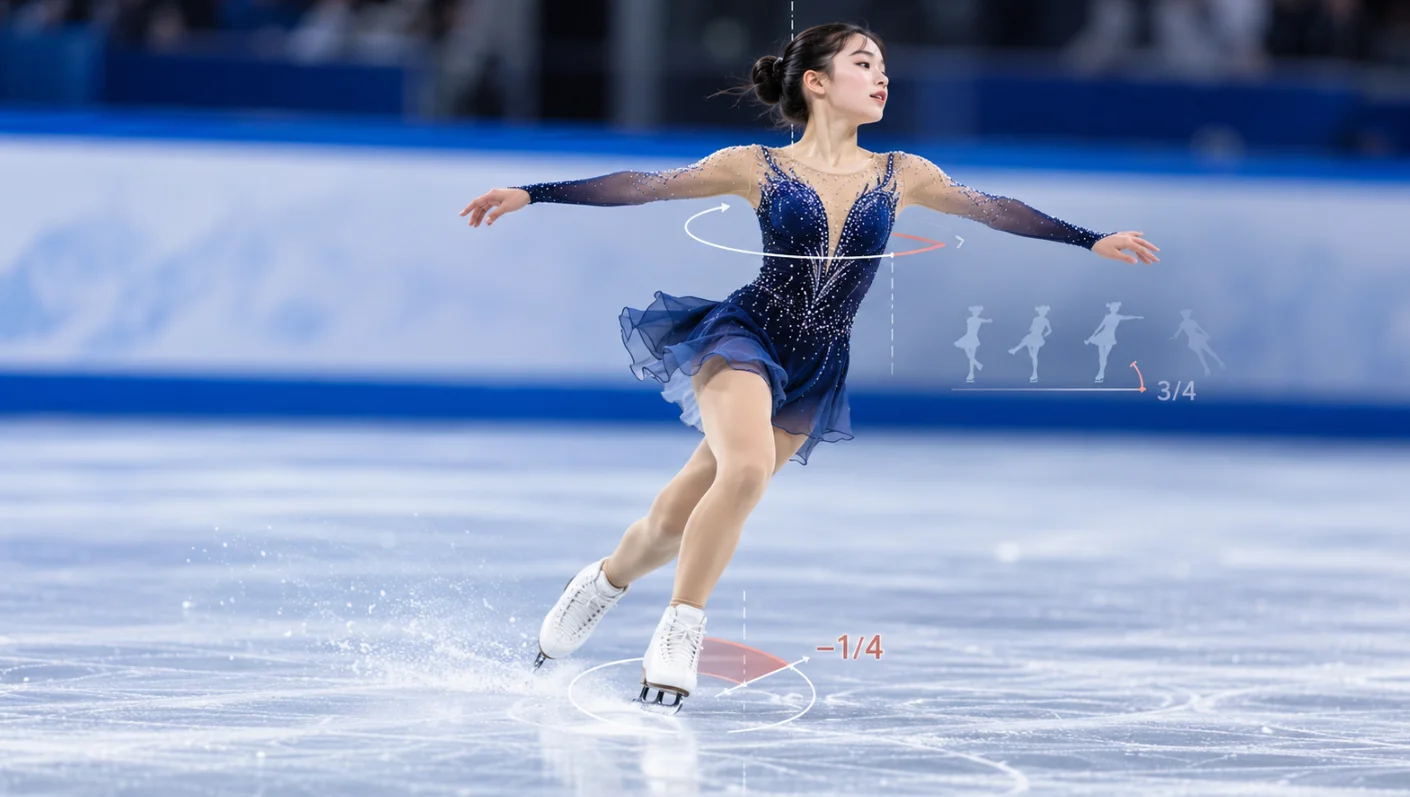
Take a triple toe loop. It is intended to complete three rotations before the skater lands on a backward outside edge. If the blade reaches the ice before the required rotation is sufficiently completed, the technical panel may identify a rotation shortage. The skater might still hold a beautiful-looking landing because the blade continues turning on the ice.
That continued movement is precisely why watching the exit alone can be misleading. The landing position at the initial contact with the ice matters, not just the direction the skater faces after gliding away.
Under the International Skating Union (ISU) rules for the 2026/27 season, missing rotation can produce three different technical calls: q, < or <<. Each has a different effect on the jump’s base value.
Three Different Rotation Calls
The ISU distinguishes between a jump landed exactly on the quarter, one missing more than a quarter but less than half a revolution, and one missing half a revolution or more. These are technical thresholds, not subjective descriptions of how awkward a landing looks.
Consider a triple toe loop, which has a standard base value of 4.20 points in the 2026/27 ISU Scale of Values.
| Technical call | Rotation missing | 2026/27 base value for 3T |
|---|---|---|
| 3T — no rotation flag | Less than ¼ turn | 4.20 |
| 3Tq — on the quarter | Exactly ¼ turn | 4.20 |
| 3T< — under-rotated | More than ¼, less than ½ | 3.36 |
| 3T<< — downgraded | ½ turn or more | 1.30 |
These are base values before Grade of Execution (GOE), timing bonuses or other adjustments. A jump without a rotation flag can still receive reduced GOE if it is visibly short by less than a quarter turn.
Landed on the Quarter: The q Call
The q symbol means the jump was landed a quarter of a revolution short. A triple toe loop marked 3Tq retains its full 4.20-point base value, but judges apply the prescribed GOE reduction.
It is tempting to treat a q as an almost-clean jump. Technically, it retains its base value, but its final score may be noticeably lower than that of a well-executed triple toe loop. The GOE depends on the full execution, including any additional errors.
For the viewer, the useful clue is a landing that looks slightly turned out or requires the blade to complete the last part of the rotation against the ice. That observation is only a clue, not enough to establish an official q call.
Under-Rotated: More Than a Quarter Turn Short
An under-rotated jump receives the < symbol. It is missing more than one-quarter but less than one-half of its intended rotation.
In the 2026/27 Scale of Values, an under-rotated jump receives 80% of its standard base value, and judges also apply GOE reductions. A triple toe loop therefore drops from 4.20 to 3.36 before GOE is calculated.
This is not the same as scoring the jump as a double. The technical panel still identifies a triple toe loop, but with an under-rotation designation and reduced value.
In a close junior competition, that difference can matter. A skater may lose the base-value advantage of a difficult jump and then lose additional execution points, even after recovering enough balance to make the landing appear controlled.
Downgraded: Half a Turn or More Missing
A downgrade is the more severe rotation call. The << symbol means the jump is missing half a revolution or more.
Instead of merely reducing the base value by a percentage, the technical panel evaluates the jump using the Scale of Values for the same jump with one fewer rotation.
A downgraded triple toe loop, written 3T<<, therefore receives the base value of a double toe loop: 1.30 points. The judges then evaluate execution, including the downgrade-related GOE reduction.
This is why a jump that looked ambitious can end up contributing surprisingly little to the technical score. The downgrade changes the underlying value before the judges’ quality marks are applied.
There is one further distinction worth recognising: a clearly cheated take-off can also affect a jump’s identification. The ISU technical handbook addresses jumps where the skater turns excessively on the ice before leaving it. Rotation is not assessed simply by counting how many times the skater’s body appears to turn between two broadcast frames.
Wrong-Edge Calls: Why the Flip and Lutz Are Different
Rotation is only one part of a technically correct jump. The flip and Lutz are both toe-assisted jumps, but their take-off edges are different. A flip takes off from a backward inside edge; a Lutz takes off from a backward outside edge.
For a typical counter-clockwise jumper, that means checking the left skate immediately before the right toe pick assists the take-off. The edge of the left blade determines whether the jump meets the requirements for a flip or a Lutz.
A Lutz is particularly demanding because its outside-edge approach works against the skater’s natural direction of rotation. If the skater changes to an inside edge just before taking off, the result is commonly called a “flutz.”
An Unclear Edge Versus an Incorrect Edge
Two symbols identify problems with the take-off edge:
- ! means the technical panel considers the edge unclear. The jump retains its normal base value, but the judges account for the problem in GOE.
- e means the take-off edge was definitely incorrect. The jump receives the applicable reduced base value and is also subject to GOE reductions.
For example, an ordinary triple Lutz has a base value of 5.90 points in 2026/27. A triple Lutz with an incorrect-edge call, written 3Lze, has a reduced base value of 4.72.
Rotation and edge errors can occur together. A 3Lze< carries both an incorrect-edge call and an under-rotation call. Its listed base value is 3.54 points, before GOE.
That combination of problems can substantially reduce a jump’s value without the skater ever touching the ice with a hand or knee. An edge call is also different from landing on the wrong edge: flip and Lutz edge calls concern the take-off.
Who Makes the Call During a Competition?
Technical calls are made by the technical panel, not by the individual judges who award GOE. At ISU competitions, the panel includes technical specialists and a technical controller, supported by data and video replay operators.
The technical specialists identify the performed elements and their relevant technical features. The controller supervises the process and participates in resolving disputed calls. Judges separately evaluate the quality of execution and assign GOE grades.
During a performance, an element may initially be identified without a final rotation or edge decision. The technical panel can request a review and examine the relevant video before authorising the element list.
The 2026/27 ISU Technical Panel Handbook recommends different replay speeds depending on the issue: super-slow motion for jump landings, slow motion for take-off edges, and regular speed for certain take-off assessments and falls. This distinction reflects the fact that different technical questions require different visual evidence.
Once you know who makes each call, it becomes easier to understand what the live scoreboard is showing while a performance is being reviewed. A technical number displayed during the skate may change after the panel confirms its decisions.
Official judging protocols then show the executed jump codes, technical symbols, base values, GOE adjustments and final element scores. For international events, these are generally available through the ISU results service. Skate Canada and its provincial or territorial sections also publish competition results, with requirements varying by category.
When comparing a domestic STAR event with an international junior competition, use the appropriate Skate Canada technical requirements and Scale of Values rather than assuming every event follows an identical scoring configuration.
Why a Fall, Step-Out and Under-Rotation Are Not the Same Mistake
Landing errors and rotation errors are related, but they describe different things. A skater can step out of a fully rotated jump, land an under-rotated jump without falling, or combine several errors in one attempt.
| Problem | What a viewer may notice | Scoring consequence |
|---|---|---|
| Under-rotation | The blade lands before the required rotation is sufficiently completed. | Technical panel reduces base value; judges reduce GOE. |
| Downgrade | A substantial rotation shortage, potentially followed by a controlled exit. | Base value corresponds to a jump with one fewer rotation; GOE is affected. |
| Step-out | The skater steps onto the other foot after landing. | Judges reduce GOE; no automatic rotation call. |
| Fall | The skater loses control and substantial body weight is supported by the ice. | Negative GOE and the applicable separate fall deduction. |
| Incorrect take-off edge | The blade rolls onto the wrong edge before a flip or Lutz. | Technical panel assigns e; base value and GOE are affected. |
A fall does not automatically mean the jump was under-rotated. A skater can complete the intended rotations and still lose control on landing. Conversely, a skater may save an under-rotated jump with excellent balance.
Several errors can also compound. A jump may be under-rotated, followed by a step-out, and receive negative GOE for both problems. If a fall occurs, the separate deduction may apply as well.
The official protocol helps separate what happened technically from how the performance was judged. That separation is more reliable than assuming every visible mistake has the same scoring effect.
What You Can Actually Spot From a Broadcast Replay
A good replay can reveal a great deal, but it is not equivalent to the video evidence available to the technical panel. Camera position, motion blur, the skater’s body angle and the exact point of blade contact all affect what a viewer can determine.
For a more useful replay assessment, concentrate on four details:
- Identify the jump first. A triple Axel and a triple Lutz have different take-offs. Knowing the element prevents confusion about the required rotations.
- Watch the actual take-off. Look for the toe-pick assistance or edge departure. Be alert to visible rotation occurring on the ice before take-off.
- Find the first landing contact. Try to identify the blade’s position as it first touches down, rather than judging only the direction of the subsequent glide.
- Separate rotation from landing quality. A step-out or shaky exit tells you something about execution, but does not establish how much rotation was missing.
A camera angle looking almost directly along the landing curve may conceal the blade’s exact orientation. A side angle can make a landing look more rotated or less rotated than it really is. Even slow-motion footage may be inconclusive if the skate is hidden by the skater’s body.
There is also a practical limit to counting rotations by eye. The technical distinction between a quarter and slightly more than a quarter of a revolution is narrow. At full competition speed, that difference is rarely something a viewer should claim with certainty.
The most useful habit is to form a tentative impression, then compare it with the official call. Over time, the connection between what you see and what appears in the protocol becomes easier to recognise.
Three Jump Calls to Practise Reading
The following examples are hypothetical teaching scenarios, using the 2026/27 ISU jump notation. They illustrate how a technical panel’s identification differs from a viewer’s first impression.
Scenario 1: A Fully Rotated Jump With Negative GOE
A skater completes a triple Salchow, lands backward, but immediately steps onto the free foot to avoid losing balance. The element is identified as 3S, without a rotation symbol.
The standard base value is 4.30 points. Judges reduce GOE for the step-out, but the jump does not automatically become under-rotated or downgraded. The landing was unsuccessful in quality, not necessarily in completed rotation.
Scenario 2: An Under-Rotated Second Jump in a Combination
A skater performs a triple Lutz followed by a triple toe loop. The Lutz is fully rotated, but the toe loop lands more than a quarter turn short.
The protocol shows 3Lz+3T<. The triple Lutz retains its 5.90-point base value, while the under-rotated toe loop receives 3.36 instead of 4.20.
The combination’s base value is therefore 9.26 rather than 10.10, before GOE or any applicable timing bonus. The rotation call applies to the toe loop, not the Lutz. The judges then evaluate the execution of the combination as a whole.
Scenario 3: A Lutz With an Incorrect Take-Off Edge
A skater approaches a triple Lutz on a backward outside edge but visibly changes to the inside edge before the toe-assisted take-off. The jump rotates fully and the landing is controlled.
If the technical panel determines that the take-off edge was definitely wrong, the code becomes 3Lze. The base value is 4.72 rather than 5.90, and the judges also account for the edge error in GOE.
The landing alone would not reveal the reason for the lower score. You would need to watch the take-off and then check the official technical notation.
These three cases show why the answer to “Was that jump clean?” is rarely as simple as whether the skater stayed upright. Rotation, take-off technique and execution quality are assessed through different parts of the judging system.
When watching your next competition, try identifying the jump and predicting whether its rotation might be reviewed before looking at the live technical score. Then check the published protocol. You may discover that the most revealing moment of a jump is not the landing pose, but the fraction of a second when the blade first meets the ice.
Sources and editorial notes: Technical definitions, calling procedures and GOE guidance are based on the International Skating Union’s Technical Panel Handbook — Single Skating 2026/27 (July 15, 2026), ISU Communication No. 2788 (Levels of Difficulty and Guidelines for Marking GOE, 2026/27) and ISU Communication No. 2786 (Scale of Values, 2026/27). Skate Canada’s 2026/27 technical resources provide the domestic competition context. All practice scenarios are illustrative rather than reported competition results.