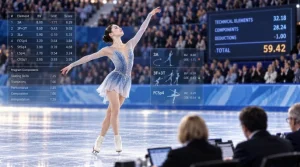
The six figure skating jumps, and how to tell them apart
Toe jumps and edge jumps, the flip versus the Lutz, why the Axel is the odd one out, and how every jump is scored — explained for first-time watchers and improving skaters alike.
Figure skating jumps, explained simply: a skater launches off one edge of one skate, turns one or more full rotations in the air, and lands backward on the outside edge of the other foot. There are only six recognised jumps, and once you know the single question that sorts them, telling a flip from a Lutz on television stops feeling like a magic trick.
That one question is this: did the skater stab the ice with a toe pick to launch, or did they spring straight off the blade’s edge? The toe pick is the cluster of teeth at the front of the blade. Jumps that use it to vault into the air are the toe jumps — the toe loop, the flip and the Lutz. Jumps that take off purely from the curving edge of the blade are the edge jumps — the Salchow, the loop and the Axel. Three and three. That is the whole map.
Before any of that matters, though, remember that jumps rest on edges. Every skate blade has two edges — an inside edge nearer the arch of the foot and an outside edge nearer the little toe — and a hollow groove between them. Skaters spend years learning to glide, turn and control those edges before a jump is ever safe. If you are brand new to the ice, edges and balance come first; the jumps are what all that quiet edge work is building towards.
Why bother learning the difference at all? Because it transforms watching. A jump that was once a blur of speed becomes a readable sequence: the set-up edge, the toe-pick stab or clean spring, the count of rotations, the landing. You start to anticipate what is coming, to understand why one jump draws gasps and another a polite ripple, and to follow the commentary instead of being carried along by it. Skaters and coaches read these cues in a fraction of a second; with a little practice, so can you from the stands or the sofa.
Toe jumps
Toe loop, flip and Lutz. The free foot’s toe pick plants in the ice and vaults the skater up, like a pole’s tip. Look for a sharp little stab just before take-off.
Edge jumps
Salchow, loop and Axel. No toe pick — the skater springs straight off the curving edge of the gliding blade. They seem to rise out of the ice rather than off it.
The Axel is special
It is the only jump taken off while skating forward, which forces an extra half rotation in the air. That is why a “triple” Axel is really three and a half turns.
The field guide
The six jumps, from easiest to hardest
Ordered by their usual difficulty. The “tell” column is what to watch for when you are trying to name a jump in real time.
Jump
Family
Take-off
The tell
Toe loop
Toe
Back outside edge, same foot
The simplest toe jump; a quick toe-pick stab, often tacked onto the end of a combination.
Salchow
Edge
Back inside edge, switches feet
The free leg swings around and up like a gate; lands on the other foot.
Loop
Edge
Back outside edge, same foot
Seems to “pop” straight up and land on the same foot it left from.
Flip
Toe
Back inside edge + toe pick
A toe jump off the inside edge of the left skate; easy to confuse with the Lutz.
Lutz
Toe
Back outside edge + toe pick
A long glide backwards on the left foot in a shallow curve before the stab; wrong edge = a “flutz”.
Axel
Edge
Forward outside edge
The only forward take-off — the skater faces where they are going, then an extra half turn.
Difficulty is not fixed in stone — it depends on the skater — but this order is the one coaches and the scoring system broadly agree on, which is why a triple Lutz is worth more than a triple toe loop. The jump that trips up new fans most is the flip-versus-Lutz pair, so it gets its own section below.
Interactive · Jump identifier
Name that jump
Answer two quick questions the way you would read a jump on screen, and we will name it and tell you exactly what to watch for next time.
1. Toe pick or pure edge?
2. What does the take-off look like?
A learning aid, not an official call — even judges use slow-motion replays for edge calls on the flip and Lutz.
The one everyone confuses
Flip versus Lutz
These two look almost identical: both are toe jumps, both take off backwards from the left foot with a toe-pick stab from the right, and both land on the right back outside edge. The entire difference lives in one detail — the edge of the left skate at take-off.
The flip launches from the inside edge of the left skate. The Lutz launches from the outside edge. Because the outside edge curves against the natural direction of rotation, the Lutz is harder, and so it is worth more. The visual cue: a Lutz is usually preceded by a long, patient glide backwards on the left foot in a shallow curve across the rink before the skater reaches back and stabs.
When a skater is supposed to do a Lutz but rolls onto the inside edge at the last instant, commentators call it a “flutz” — a flip pretending to be a Lutz. Judges watch for exactly this and deduct for the wrong edge. Now that you know where to look, you will start spotting flutzes before the commentators say a word.
From the journal
Reading, watching & learning
New explainers on jumps, scoring and the finer points of the sport. Read the blog →
The name of a jump tells you its take-off; the number in front tells you how many full turns the skater completes in the air before landing. Each extra rotation multiplies both the difficulty and the reward.
Single
1 rotation
Double
2 rotations
Triple
3 rotations
Quad
4 rotations
A jump only counts as a triple if the skater completes all three turns in the air. Land a fraction short and the technical panel flags it as under-rotated (losing value) or downgraded (scored as the lower jump). This is why you will hear commentators debate whether a jump was “fully rotated” — a few degrees can mean a large swing in points. The Axel, remember, always carries that extra half turn, so a triple Axel is three and a half rotations and one of the hardest jumps in the sport.
Not just jumps
Spins and step sequences
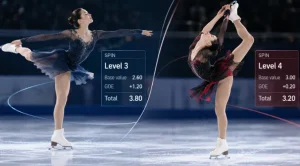
Jumps grab the headlines, but a program is built just as much on spins and footwork, and they carry real points too. The three basic spin positions are the upright, the sit (down low, as if sitting on an invisible chair) and the camel (the free leg extended behind, body parallel to the ice). Combine and vary them, add a flying entry, and the difficulty — and the score — climbs.
Spins are scored by level, from a basic Level 1 up to Level 4, earned by hitting difficult features: tricky positions, changes of edge, many revolutions. A fast, perfectly centred Level 4 spin that stays on one spot can be worth as much as a jump.
Step sequences weave turns, edges and body movement across the whole ice surface in time with the music. They are where skating artistry and blade control are most visible — and, like spins, they are levelled and judged on quality, not just completed.
Interactive · Element score builder
Build a jump pass and watch the points add up
Pick a jump, choose how many rotations, slide the grade of execution, and add it to a mock program. See how base value and GOE combine into a technical score — the way the modern judging system works.
Jump
Rotations
Grade of execution: 0
Base values are illustrative of the current era and rounded for teaching; the official scale of values is set by the sport’s rulebook and changes from season to season.
How the numbers work
How figure skating is scored
Gone are the days of a single mark out of 6.0. Modern figure skating uses a detailed points system, and once you know its two halves, the giant scores on screen suddenly make sense.
1. The Technical Element Score. Every jump, spin and step sequence has a fixed base value set by a published scale. On top of that, the judges add or subtract a Grade of Execution (GOE), from minus five to plus five, for how well the element was done — height, flow, difficulty of entry, clean landing. A soaring, effortless triple Axel earns big positive GOE; a stumbled one loses value even though the base is still counted. Add every element’s adjusted value together and you have the technical score.
2. The Program Components Score. This rewards the skating itself — skating skills, transitions, performance, composition and how the movement fits the music. Judges mark several components, which are averaged and weighted so that the artistic side carries roughly the same importance as the technical side. This is why a skater who lands fewer big jumps can still win on polish, musicality and flow.
The total. Technical score plus components score, minus any deductions (for falls, time violations or costume mishaps), gives the total segment score. Add the short program and the free skate together and you have the result. When you hear a commentator say a jump “wasn’t worth the risk,” they mean its base value and likely GOE did not justify the chance of a fall and its deduction — exactly the trade-off the score builder above lets you feel for yourself.
Why there are two programs. At most competitions each skater performs twice: a shorter program with a required set of elements, and a longer free skate where they choose their own layout within limits. The short program rewards precision under pressure — miss a required element and you simply cannot score for it — while the free skate rewards stamina and ambition, since skaters pack in their hardest jumps, often late in the program when they are tired. A skater can sit mid-pack after the short and still win on a brilliant free skate, which is why the standings so often reshuffle on the final day.
One more wrinkle worth knowing: jumps attempted in the second half of a free skate once earned a bonus, because landing on tired legs is harder. The rules around that bonus have changed over the years, but the principle explains a tactic you will still see — skaters loading their biggest jumps towards the end to squeeze out extra value. It is a gamble, because fatigue also makes falls and under-rotations more likely, and that is the knife-edge the sport is scored on.
Four ways to compete
The disciplines of figure skating
The jumps and spins show up differently across the sport’s four competitive disciplines. Here is how they differ.
Singles
One skater, judged on jumps, spins and step sequences across a short program and a longer free skate. This is where the biggest jumps — triple Axels and quads — take centre stage.
Pairs
A skater and partner performing in unison plus elements only a pair can do: overhead lifts, throw jumps, twist lifts and side-by-side jumps and spins that must match perfectly.
Ice dance
Built on intricate footwork, close holds and musical interpretation rather than jumps and throws. Think of it as ballroom dancing on ice, judged on edges, timing and togetherness.
There is also synchronized skating, where large teams skate complex formations as one unit — a spectacular, fast-growing discipline that rewards precision and trust above individual tricks. Across every discipline the engine is the same — blade, edge and balance — but the emphasis shifts from athletic jumps in singles to partnered trust in pairs to pure dance on edges in ice dance. Watch a little of each and you quickly find the one that speaks to you.
Competitive skaters also progress through a ladder of levels and tests before they ever reach a championship. In most countries, skaters pass a graded series of tests in skating skills, jumps, spins and dance, moving from entry levels up towards the senior ranks. Those tests are how a club tracks progress, and they are the quiet scaffolding beneath the sport you see on television — every quad-landing champion once passed their very first glide test on wobbly ankles.
For new skaters
How to start figure skating
You are never too old to start, and you do not begin with jumps. Almost everyone starts in a group learn-to-skate programme, where you learn to stand, glide, stop and turn safely before anything leaves the ice. Many rinks run adult classes alongside the children’s ones — find a local club or public rink and ask what they offer.
Rent skates at first; once you are hooked, a basic pair of figure boots with a proper fit beats an expensive pair that does not. A good fit and sharp blades matter far more than a famous brand. Dress in warm layers you can move in, bring gloves, and — yes — expect to fall. Learning to fall safely and get up is part of the first lesson, not a sign you are doing it wrong.
Find a local rink or skating club
Join a beginner or adult learn-to-skate class
Rent skates before buying your own
Get boots fitted; keep blades sharpened
Wear warm, flexible layers and gloves
Master gliding, stopping and turning first
Learn to fall and get up safely
Be patient — edges come before air
Watch like you know
Myths and quick clarifications
“They all look the same”
Not once you know the toe-pick question. Toe stab or clean edge sorts the six jumps into two families before you even count rotations.
“More jumps always wins”
No — components reward skating quality too. A cleaner, more musical program can beat a jump-heavy one with mistakes.
“A triple Axel is three turns”
It is three and a half. The Axel’s forward take-off always adds that extra half rotation — the reason it is so prized.
“The 6.0 still exists”
Retired long ago. Today’s open-ended points system is why scores run well past a hundred for a strong free skate.
“Falling means they lose”
A fall costs a deduction and GOE, but the element’s base value still counts. A fall on a quad can still outscore a clean easier jump.
“You must start as a child”
Plenty of adults learn to skate and even compete. Edges, balance and fitness improve at any age with coaching and time.
Questions people ask
Figure skating jumps, answered
What are the six figure skating jumps?
The six recognised jumps are the toe loop, the Salchow, the loop, the flip, the Lutz and the Axel. Three are toe jumps that use the toe pick to launch (toe loop, flip, Lutz) and three are edge jumps that spring straight off the blade’s edge (Salchow, loop, Axel). They are usually ranked, easiest to hardest, as toe loop, Salchow, loop, flip, Lutz, Axel.
How do you tell the difference between a flip and a Lutz?
Both are toe jumps that take off backwards from the left foot, so the only difference is the take-off edge of that left skate. The flip launches from the inside edge; the Lutz launches from the outside edge, which curves against the rotation and makes it harder. A Lutz is usually set up with a long backward glide in a shallow curve before the toe-pick stab. A Lutz taken off the wrong (inside) edge is nicknamed a “flutz.”
Why is the Axel considered special?
The Axel is the only jump taken off while skating forwards. Because the skater has to rotate from a forward take-off to a backward landing, every Axel carries an extra half rotation. That means a single Axel is one and a half turns, a double is two and a half, and a triple Axel is three and a half — which is why it is one of the most difficult and admired jumps in the sport.
What is the difference between a toe jump and an edge jump?
A toe jump uses the toe pick — the teeth at the front of the blade — to vault the skater into the air, like planting a pole. The toe loop, flip and Lutz are toe jumps. An edge jump takes off purely from the curving edge of the gliding blade with no toe assist; the Salchow, loop and Axel are edge jumps. Spotting the toe-pick stab is the quickest way to sort a jump into one of the two families.
How is figure skating scored?
Modern skating uses a points system with two halves. The Technical Element Score adds up a fixed base value for each jump, spin and step sequence, adjusted by a Grade of Execution from minus five to plus five for quality. The Program Components Score rewards skating skills, transitions, performance and how the program fits the music. Technical plus components, minus any deductions, gives the total. The old mark out of 6.0 is no longer used.
What does “under-rotated” mean?
A jump only earns full credit if the skater completes all of its rotations in the air. If the landing is a quarter to a half turn short, the technical panel marks it “under-rotated” and reduces its value; if it is more than half a turn short, it may be “downgraded” and scored as the lower jump. This is why commentators debate whether a jump was “fully rotated” — a few degrees can mean a big difference in points.
How many rotations are in a quad?
A quadruple jump, or quad, is four full rotations in the air — except the quad Axel, which because of the Axel’s forward take-off is four and a half rotations. Quads carry the highest base values of any jumps and are increasingly common in elite men’s singles, with a growing number of women landing them too.
Can adults learn figure skating?
Yes. Many rinks run adult learn-to-skate classes, and you begin the same way children do — learning to glide, stop and turn on secure edges before attempting any jumps. Rent skates at first, dress in warm flexible layers, and expect falling (and getting up) to be part of the first lesson. Progress depends on coaching, consistency and patience far more than on the age you start.
Watch the next one differently
Name the jump before the commentator does
Try the identifier, build a jump pass, and the next competition you watch will feel like a sport you speak the language of.