How to Read a Figure Skating Score Sheet

13 min read
Contents
- Start With the Final Score, Not the Jump Codes
- Total Element Score: What the Skater Actually Performed
- Program Component Score: The Three Judged Components
- How to Read a Single Element Row
- Element Code, Base Value and Grade of Execution
- Why Two Attempts at the Same Jump Can Score Differently
- The Symbols That Explain Lost Points
- Technical Calls Versus Fall Deductions
- A Worked Example: Two Skaters, Two Very Different Scores
- Higher Base Value, Weaker Execution
- Lower Base Value, Cleaner Skating
- Where to Find Official Figure Skating Score Sheets
- A 60-Second Score Sheet Reading Checklist
A figure skater finishes a seemingly flawless program, the crowd applauds, and then the score appears. It is lower than expected. The explanation is usually somewhere in the judging protocol, a document filled with jump codes, decimal numbers and symbols that can look more complicated than the performance itself.
Reading a figure skating score sheet becomes much easier once you know where to start. Rather than decoding every abbreviation at once, begin with the overall score, work backwards through its components, and then investigate the elements that made the difference.
Start With the Final Score, Not the Jump Codes
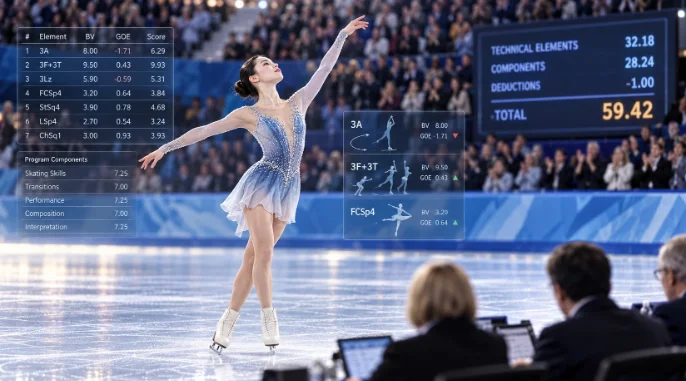
Every competitive figure skating program receives a Total Segment Score (TSS). Under the International Judging System (IJS), that score combines points for technical elements and program components, with deductions applied for certain violations.
The basic calculation is:
Total Segment Score = Technical Element Score + Program Component Score − Deductions
Consider a real example from the 2026 ISU Junior Grand Prix in Gdańsk, Poland. Canadian skater Lia Cho won the junior women’s short program with 69.42 points. Her official judging sheet shows:
- Technical Element Score (TES): 40.91
- Program Component Score (PCS): 28.51
- Deductions: 0.00
- Total Segment Score: 69.42
The arithmetic is straightforward: 40.91 + 28.51 = 69.42. The useful questions come next. Where did those 40.91 technical points come from? What earned the additional 28.51? And could a different combination of technical difficulty and skating quality have produced a better result?
Total Element Score: What the Skater Actually Performed
The TES is the combined value of the jumps, spins, step sequences and other eligible technical elements performed during the program. Each element has a base value established by the sport’s Scale of Values. Judges then reward or penalize the quality of execution through the Grade of Execution (GOE).
The technical panel identifies elements and determines their levels or technical calls where applicable. The judging panel evaluates how well those elements were performed.
This distinction matters. A skater may attempt a difficult triple jump but lose points because of an under-rotation or poor landing. Another skater might perform an easier element exceptionally well and earn enough positive GOE to narrow the gap.
On the protocol, the final score for each technical element appears in the rightmost column, usually labelled “Scores of Panel.” Adding those values gives the TES.
Program Component Score: The Three Judged Components
The PCS evaluates the program as a whole rather than assigning additional points to individual jumps. The current ISU system uses three components:
- Composition: How movements, patterns, transitions and musical structure are arranged into a coherent program.
- Presentation: How the skater communicates the music through movement, expression, energy and timing.
- Skating Skills: The quality of blade control, edges, balance, flow, speed and movement across the ice.
Judges mark these components on a scale from 0.25 to 10.00 in increments of 0.25. The panel’s calculated marks are multiplied by factors that depend on the discipline, competition category and program segment.
For example, the factor for junior women’s short programs is 1.33 for each component. In a junior women’s free skate, it is 2.67. These factors help account for differences between program formats.
Do not confuse a displayed component average, such as 7.18, with the number of points contributed directly to the final score. The weighting must be applied first.
There is also no separate fourth or fifth component for transitions or musical interpretation under the current three-component system. Those qualities are considered within the established components.
How to Read a Single Element Row
The technical section lists elements in the order the skater performed them. A typical row contains an element number, an abbreviation, possible technical flags, a base value, GOE, individual judges’ marks and the final panel score.
Understanding one row gives you the method for reading almost everything else on the sheet.
Element Code, Base Value and Grade of Execution
Suppose the executed element is written as 3Lz+2T. The code identifies a triple Lutz followed by a double toe loop in combination.
For the 2026/27 season, their standard base values are 5.90 and 1.30 points, respectively. Together, they have a base value of 7.20 before bonuses, technical adjustments or GOE.
The judges assign GOE grades from −5 to +5. Those grades are converted into numerical point adjustments using the relevant Scale of Values. In a jump combination, the GOE calculation is based on the most valuable jump in the combination, following the applicable rules.
A +3 GOE grade therefore does not simply add three points. It produces a calculated adjustment specific to the element.
Here is a more informative example from Lia Cho’s actual Gdańsk short-program protocol:
- Executed element: 3F+3T — triple flip followed by triple toe loop.
- Base value: 10.45 points, including the eligible second-half bonus.
- GOE adjustment: +1.67 points.
- Final element score: 12.12 points.
Without the timing bonus, the two jumps have a combined base value of 9.50. The protocol’s x marker identifies the eligible 10% increase, bringing the displayed base value to 10.45. Positive GOE then raises the element’s final score to 12.12.
That single combination contributed nearly 30% of Cho’s total technical score for the short program.
The nine columns labelled J1 through J9 show individual judges’ GOE grades. In a nine-judge panel, the highest and lowest marks are excluded before calculating the trimmed mean. The resulting GOE point adjustment, rather than a raw average of the displayed integers, is what the protocol adds to the base value.
Why Two Attempts at the Same Jump Can Score Differently
Consider two hypothetical triple Lutz attempts with the same standard base value of 5.90 points.
In the first, the skater achieves good height, clear rotation and a controlled landing with strong flow. Suppose the panel’s calculated GOE adjustment is +1.18. The element earns 7.08 points.
In the second, the skater completes the rotation but makes a significant landing error. If the GOE adjustment is −1.77, the element earns only 4.13 points.
These are illustrative calculations, not results from a particular competition. Their purpose is to show how execution can create a substantial scoring difference even when the technical panel identifies the same jump.
A technical call can change the base value as well. That is why the next place to look is the small Info column beside the element code.
The Symbols That Explain Lost Points
The symbols beside an element often explain an unexpected score more quickly than the judges’ individual marks. Some change the base value; others signal a condition that judges must consider when assigning GOE.
| Symbol | Meaning | What to check |
|---|---|---|
| q | Jump landed on the quarter | Full base value remains, but GOE is affected. |
| < | Under-rotated jump | Reduced base value and negative GOE considerations. |
| << | Downgraded jump | Scored using the base value for one fewer rotation. |
| ! | Unclear take-off edge on a flip or Lutz | Full base value, with an appropriate GOE reduction. |
| e | Incorrect take-off edge | Applicable reduced base value and GOE consequences. |
| x | Eligible second-half jump bonus | Increased base value, not a penalty. |
| REP | Repeated jump subject to the repetition rule | Reduced value for the affected element. |
| * | Invalid element | No value awarded for the invalid element. |
| V | Reduced-value spin call | A required spin feature or condition was not fulfilled. |
These symbols are not interchangeable. An under-rotated triple is still identified as a triple with reduced value, while a downgraded triple receives the base value of the corresponding double jump. The q call is different again: it identifies a landing on the quarter without automatically reducing the jump’s base value.
Likewise, the x marker is positive. It identifies an eligible jump element receiving a timing bonus, not a technical error. Its application depends on the program and season rules.
Technical notation is particularly useful when reviewing a combination. A symbol may apply to one jump within the combination rather than every jump in the sequence.
Technical Calls Versus Fall Deductions
A fall can affect the score in two separate places. First, judges apply negative GOE to the element because its execution was unsuccessful. Second, the program receives the applicable fall deduction under the rules for that category.
For example, a skater may receive substantial negative GOE on a jump and also have one point deducted from the segment total for a fall. These are not duplicate entries or a calculation error. They assess different consequences of the same incident.
Not every visibly awkward landing is officially a fall. A step-out, touchdown or loss of balance may reduce GOE without triggering a separate fall deduction.
When a result looks unusually low, check both the element row and the deductions section near the bottom of the protocol.
A Worked Example: Two Skaters, Two Very Different Scores
The junior women’s short program at the 2026 ISU Junior Grand Prix Gdańsk offers a particularly useful comparison. Canada’s Lia Cho finished first, just 0.18 points ahead of Japan’s Sumika Kanazawa.
Both results are drawn from the official ISU judges’ details for October 8, 2026, rather than a constructed scoring scenario.
| Scoring measure | Lia Cho (CAN) | Sumika Kanazawa (JPN) |
|---|---|---|
| Technical base value total | 33.25 | 34.59 |
| Net GOE adjustment | +7.66 | +5.13 |
| Technical Element Score | 40.91 | 39.72 |
| Program Component Score | 28.51 | 29.52 |
| Deductions | 0.00 | 0.00 |
| Total Segment Score | 69.42 | 69.24 |
Higher Base Value, Weaker Execution
Kanazawa’s executed technical elements had a combined base value of 34.59, which was 1.34 points higher than Cho’s. That is a meaningful advantage before GOE is applied.
One revealing row is Kanazawa’s triple Lutz, recorded as 3Lzq. It received the second-half bonus, giving it a base value of 6.49, but the quarter-landing call contributed to a negative GOE adjustment of −0.42. Its final value was 6.07.
Kanazawa’s other elements earned positive GOE, including a Level 4 step sequence worth 5.56 points. Her program also received the stronger PCS of the two. Yet the overall technical advantage she could have gained from her higher base values did not materialize.
Lower Base Value, Cleaner Skating
Cho’s elements began with a combined base value of 33.25, but earned a total positive GOE adjustment of 7.66. Her triple Lutz alone gained 1.52 points above its standard base value, finishing at 7.42.
Her triple flip–triple toe loop combination added 12.12 points, and every executed element on her protocol received positive GOE.
The result was a TES of 40.91, compared with Kanazawa’s 39.72. Kanazawa recovered 1.01 points through her higher PCS, but Cho still finished 0.18 ahead.
This comparison reveals something a simple ranking cannot: Kanazawa had the higher combined base value and stronger program components, while Cho earned enough additional execution points to win the segment.
It also illustrates why separating technical difficulty from execution quality is essential. Neither the list of planned jumps nor the final total alone explains the competitive result.
One further distinction: these were short-program scores, not final competition totals. The free skate was a separate segment, and the combined score determined the event’s final standings.
Where to Find Official Figure Skating Score Sheets
For international competitions, the International Skating Union publishes results through its official results service. Event pages usually provide starting orders, segment standings, final classifications and downloadable judging details.
Look for labels such as Judges Scores (PDF), Judges Details Per Skater or Detailed Classification. The exact wording and layout can vary.
The 2026 Junior Grand Prix Gdańsk results offer a useful starting example. Choose Junior Women, then Short Program, then the judges’ scores document. The first page contains the detailed results for Lia Cho and Sumika Kanazawa used above.
For Canadian competitions, Skate Canada’s official Results section links to events including the Canadian National Skating Championships, Skate Canada Challenge and NextGen competitions. Some event results are displayed through dedicated systems rather than conventional downloadable PDF files.
The 2026 NextGen Competition in Gatineau, Quebec, for example, brought together junior-level skaters competing for consideration for international assignments. Its official event information provides a useful entry point for tracking results from a Canadian development-level competition.
If you’re new to the event itself, it helps to follow a competition from the start order to the final standings before opening the detailed judging sheets. You will then know which segment you are examining and how that result fits into the overall competition.
When downloading a protocol, check three things before comparing it with another document:
- Season: The ISU updates technical requirements and the Scale of Values. A protocol from 2025/26 may use different values or element requirements from one in 2026/27.
- Category: Senior, junior and domestic developmental categories can have different program requirements and component factors.
- Segment: Short-program scores should not be directly compared with free-skate totals without accounting for their different structures.
Skate Canada also uses category-specific rules and weighting factors for domestic competitions, including STAR and novice events. An international junior judging protocol is therefore a useful teaching example, but it should not be treated as the scoring template for every local club competition.
Finally, remember that the technical number shown during a live broadcast can be provisional. The technical panel may review elements and revise calls, while the complete PCS and deductions are incorporated into the segment result. For a reliable analysis, use the published judges’ details after the result has been authorized rather than relying on a screenshot of the live technical score.
A 60-Second Score Sheet Reading Checklist
You do not need to inspect every judge’s mark to understand the basic story behind a performance. When you open an unfamiliar protocol, work through these five steps:
- Find the Total Segment Score. Confirm the competition, category and program segment. Check whether you are looking at a single segment or a combined event result.
- Compare TES and PCS. Decide whether the score came mainly from technical elements, overall program quality or a balance of both.
- Scan the element codes and Info column. Look for under-rotations, edge calls, invalid elements and bonuses. Identify which elements received unusually high or negative GOE.
- Check deductions. See whether falls or other violations reduced the final score beyond the adjustments already made to individual elements.
- Compare another skater’s sheet. Look at base values, net GOE and PCS separately. The largest difference in any one of these may explain the final ranking.
For a deeper analysis, return to the individual judges’ marks and examine how consistently an element was evaluated. A wide spread of GOE grades can be interesting, although the published protocol alone does not explain each judge’s reasoning.
The best place to practise is with two skaters whose totals are close. A difference of a few tenths forces you to look beyond the obvious jumps and notice how the scoring system rewards execution, skating quality and technical content together.
Once the columns become familiar, the protocol stops looking like a wall of numbers. It becomes a record of what the skater attempted, what the technical panel recognised and how the judges evaluated the performance — often revealing far more than the final score shown on television.
Editorial source note: The real competition figures in this article are taken from the International Skating Union’s official Judges Details Per Skater, Junior Women Short Program, ISU Junior Grand Prix Gdańsk, October 8, 2026. Technical explanations reflect the ISU’s 2026/27 scoring framework and Skate Canada’s Scoring of Skate Canada Competitions rules, updated June 30, 2026. Hypothetical calculations are identified separately.