How to Watch a Figure Skating Competition: From Warm-Up to Final Results

19 min read
Contents
- Before You Watch: Find the Event, Schedule and Start Order
- Where to Find Canadian and International Competitions
- Why the Start Order and Warm-Up Groups Matter
- Know Which Discipline You’re Watching
- Men’s and Women’s Singles
- Pair Skating
- Ice Dance
- Short Program Versus Free Skate: What Changes?
- The First Segment Establishes the Standings
- The Free Skate Can Change the Podium
- How to Follow a Performance Without Missing the Important Parts
- Look at the Set-Up Before a Jump
- Watch Spins and Step Sequences Between the Jumps
- Notice Speed, Flow and Musical Timing
- Read the Live Score Without Treating It as Final
- Technical Scores Can Change After Review
- Why the Final Score Appears After the Program
- Why the Judges’ Score May Surprise You
- High-Difficulty Jumps Do Not Guarantee a High Score
- A Spin Can Be Valuable Without Looking Spectacular
- The Official Protocol Explains the Numbers
- How Junior Competitions Differ From Senior Events
- Different Requirements, Different Competitive Contexts
- Following Canadian Junior Skaters
- Make Watching More Interactive Without Losing the Sport
- Your First-Competition Viewing Checklist
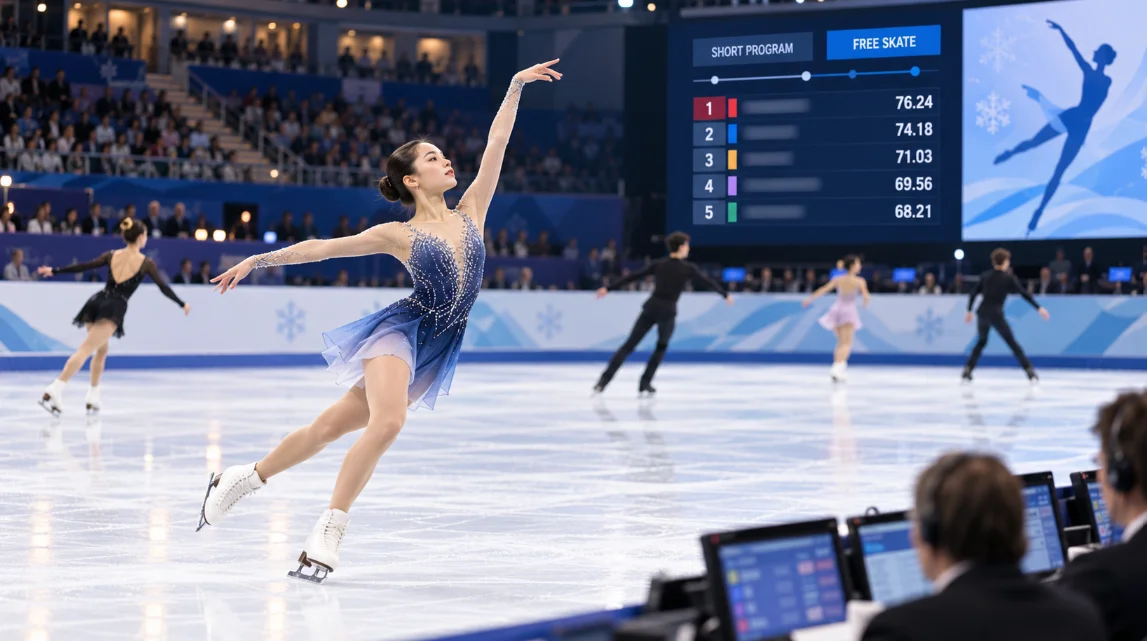
You turn on a figure skating competition halfway through a warm-up. Six skaters are circling the ice, the commentator mentions a short-program ranking, and a row of numbers appears beside someone’s name. Ten minutes later, the standings have changed again. What exactly are you watching?
Following figure skating is much easier once you understand how a competition unfolds: the start order, the two programs, what to watch during a performance and how the scores determine the winner. You do not need to recognise every jump or know the judging rulebook. A few well-chosen things to watch for will make your next competition considerably more rewarding.
Before You Watch: Find the Event, Schedule and Start Order
The first step is identifying the competition and the segment being skated. A World Championship, an ISU Junior Grand Prix event and a domestic Skate Canada competition may look similar on television, but they serve different purposes and can have different entry rules.
Find the official event page before opening the stream. Ideally, you want three things available: the schedule, the starting order and the results page. Keeping the starting order open on another screen makes it easier to follow competitors you have never seen before.
Where to Find Canadian and International Competitions
For events in Canada, Skate Canada’s website is a useful starting point. Its event pages provide competition information, schedules and access to results. The organisation’s video hub also carries live and archived coverage of domestic competitions, including events organised by provincial and territorial skating sections.
The International Skating Union (ISU) maintains the calendar and official results for major international competitions. These include the Junior Grand Prix, senior Grand Prix, World Junior Championships and World Championships.
The Junior Grand Prix is a series of international competitions where eligible young skaters represent their countries. The 2026/27 series featured seven events, with results contributing toward qualification for the Junior Grand Prix Final. The World Junior Championships are a separate championship, not another regular Junior Grand Prix stop.
Broadcast availability depends on the event and territory. For the 2026/27 Junior Grand Prix series, the ISU announced coverage on its official YouTube channel for viewers outside certain broadcast territories, including Canada. Senior Grand Prix coverage has different broadcast arrangements; for Skate Canada International 2026, the ISU listed CBC and YouTube for Canadian audiences.
Check the official event’s viewing information rather than assuming the same streaming arrangement applies throughout the season. For international competitions, also convert the published local start time to your own time zone. A morning event in Europe may begin before sunrise in British Columbia.
Why the Start Order and Warm-Up Groups Matter
The start order tells you who skates next, while the warm-up group identifies the competitors sharing the ice immediately before their performances.
In singles competitions, a warm-up group commonly contains up to six skaters. Each group gets time to practise before its members perform individually. Pair and ice dance groups are generally smaller because more space is needed.
Do not read too much into the first segment’s start order. Depending on the competition rules, initial starting positions may be determined by draws or other prescribed procedures. Skating early does not automatically mean someone is less skilled.
The second segment is more informative. Skaters are commonly grouped according to their results in the first program, with higher-ranked competitors appearing later. This means the final warm-up group often contains the main medal contenders, although the precise draw procedure varies by event.
One detail worth remembering: a warm-up group is not a ranking. The order in which its members skate still matters, and the results can change substantially before the final competitor finishes.
Know Which Discipline You’re Watching
Major international figure skating competitions feature four competitive disciplines: men’s singles, women’s singles, pair skating and ice dance. They share the same broad scoring principles but place different demands on the athletes.
| Discipline | What to watch | Competition segments |
|---|---|---|
| Men’s singles | Jumps, spins, step sequences and overall skating quality | Short Program + Free Skate |
| Women’s singles | Jumps, spins, footwork, speed and presentation | Short Program + Free Skate |
| Pair skating | Overhead lifts, twist lifts, throw jumps, side-by-side elements and coordination | Short Program + Free Skate |
| Ice dance | Edges, intricate steps, holds, twizzles, lifts and musical interpretation | Rhythm Dance + Free Dance |
Men’s and Women’s Singles
Singles skating provides the clearest introduction to jumps. Each skater performs alone, combining technical elements with movements choreographed to music. The six recognised jump types—Axel, Lutz, flip, loop, Salchow and toe loop—can be performed with different numbers of rotations.
Watch the spaces between the jumps as well. Changes of direction, steps, speed and transitions reveal how comfortably a skater controls the blade. Two competitors may land similar jumps but create very different impressions through their skating skills and presentation.
Pair Skating
Pairs combine individual skating skills with demanding partnered elements. In a throw jump, one partner helps launch the other into the air before a solo landing. A twist lift involves launching, rotating and catching a partner, while overhead lifts require strength, timing and controlled movement across the ice.
Look for whether the partners maintain unison during side-by-side jumps and spins. A pair can complete a difficult lift successfully yet lose quality points if the entry, position or exit is unstable.
Ice Dance
Ice dance is built around coordinated movement, musical timing and the quality of edges rather than high-rotation jumps. Partners perform demanding sequences of turns and steps while maintaining prescribed connections and demonstrating controlled changes of direction.
Twizzles—rapid travelling rotations on one foot—are among the easiest elements for a new viewer to recognise. Notice whether both partners rotate at the same time and travel in matching patterns.
The Rhythm Dance follows seasonal musical and technical requirements, while the Free Dance allows a broader choreographic interpretation within its required elements. Difficult lifts, step sequences and transitions are important, but the strongest performances also make the partnership appear effortless.
Short Program Versus Free Skate: What Changes?
Most international competitions have two scored segments. Singles and pairs begin with a Short Program and finish with a Free Skate. Ice dance uses a Rhythm Dance and Free Dance.
The short program is tightly prescribed, with limited time and required elements. Singles skaters have approximately two minutes and 40 seconds to perform seven prescribed technical elements under the 2026/27 rules. The free skate is longer and offers more freedom in how the technical content and choreography are arranged.
Senior singles free skates last approximately four minutes, while junior singles free skates last approximately three minutes and 30 seconds. The precise requirements and permitted elements depend on the category and season.
The First Segment Establishes the Standings
Once all competitors complete their short programs, they are ranked by their segment scores. Those standings establish the competitive situation before the free skate, but they do not determine the final medals.
At some championships, only a specified number of competitors advance to the second segment. At other events, the eligible field continues without the same qualification cut. Check the event’s announcement rather than assuming every championship uses the same format.
A short-program lead can be valuable, particularly when the scores are close. It gives the leading skater points that competitors must overcome in the free skate. But the longer program usually offers more opportunities to gain or lose points.
The Free Skate Can Change the Podium
A real example from the 2026 ISU Junior Grand Prix in Gdańsk shows how quickly the standings can reverse.
Canadian skater Lia Cho led the junior women’s short program with 69.42 points. Japan’s Sumika Kanazawa was second with 69.24, just 0.18 points behind.
| Score | Lia Cho (CAN) | Sumika Kanazawa (JPN) |
|---|---|---|
| Short Program | 69.42 (1st) | 69.24 (2nd) |
| Free Skate | 126.34 (2nd) | 127.13 (1st) |
| Combined score | 195.76 (2nd) | 196.37 (1st) |
Kanazawa outscored Cho by 0.79 in the free skate, enough to overturn the short-program deficit and win by 0.61 points overall. Cho’s first-place finish in the opening segment did not guarantee first place in the competition.
These were the official results from October 2026, not hypothetical figures. They demonstrate why the combined total matters more than either segment ranking on its own.
The same principle applies throughout the sport: a competitor does not need to win both programs to win the event. The highest eligible combined score determines the final placing, subject to the applicable tie-breaking rules.
How to Follow a Performance Without Missing the Important Parts
Trying to identify every technical element during your first competition can make the experience unnecessarily stressful. A more useful approach is to divide your attention into three layers: the setup before jumps, the elements between them, and the quality of movement connecting everything together.
Look at the Set-Up Before a Jump
The half-second before take-off often tells you more about a jump than the rotation itself. Watch the skater’s direction, the edge used and whether the free foot’s toe pick assists the take-off.
Toe-assisted jumps—the toe loop, flip and Lutz—use a toe-pick plant to help launch the skater. Edge jumps—the Salchow, loop and Axel—take off directly from the skating blade’s edge.
The Axel is easiest to distinguish because it takes off forward. Every other recognised jump takes off backward, so the Axel requires an extra half rotation to land backward.
For the flip and Lutz, the difference is subtler. Both use the toe pick, but the flip takes off from a backward inside edge while the Lutz requires a backward outside edge.
Instead of counting rotations immediately, identify the jump family first. That narrows the possibilities and allows you to judge the execution with less guesswork.
Watch Spins and Step Sequences Between the Jumps
Spins and footwork are not filler between the big jumps. They carry technical value and contribute to the structure of a program.
In a sit spin, the skater rotates low on a deeply bent knee. A camel spin features an extended free leg, while an upright spin keeps the body generally more vertical. Difficult variations, changes of foot and controlled shifts in position can increase the technical level.
Step sequences bring turns and edges together across the ice. They are especially useful for observing a skater’s blade control because the movements involve frequent changes of direction rather than repeated jumps.
During the 2026/27 season, junior singles free programs use a choreographic sequence rather than the levelled step sequence required in the senior free skate. This is one reason to pay attention to the age category before comparing layouts.
Watch for how naturally these elements fit the music. A spin that remains centred and finishes on a musical accent can feel as satisfying as a clean jump, even though it attracts less attention from casual viewers.
Notice Speed, Flow and Musical Timing
Good skating often looks easier than it is. Strong edges let a skater travel across the rink efficiently, change direction smoothly and maintain speed through demanding steps.
One practical test is to watch what happens after a difficult element. Does the skater glide comfortably into the next movement, or do they need several awkward steps to recover?
Notice the relationship between the choreography and the music as well. A convincing program has changes in energy, rhythm and movement that correspond to what you hear. Skaters should appear connected to the composition rather than simply completing elements while music happens in the background.
You do not need to assign your own artistic marks. Observing differences in speed, control and musicality is enough to understand why judges may favour one performance over another.
Read the Live Score Without Treating It as Final
The technical score shown during a performance is not necessarily the final Technical Element Score. It is a running indication of the value being accumulated, and some elements can still be reviewed.
The modern judging system has two principal scoring parts: Technical Element Score (TES) and Program Component Score (PCS). Deductions are then subtracted to produce the Total Segment Score.
Technical Scores Can Change After Review
As elements are performed, the technical panel identifies jumps, spins, step sequences and other required elements. Each has a base value. Judges independently award Grade of Execution (GOE) from −5 to +5, with those grades converted into point adjustments.
Some calls require a closer examination. A jump that appears fully rotated during the performance may receive an under-rotation designation after video review. A spin may also be assigned a lower level than initially expected if a feature does not meet the technical requirements.
This explains why the live technical total sometimes changes while the skater waits for the score. It does not mean points were arbitrarily removed; the panel may have revised an element’s identification or value.
Why the Final Score Appears After the Program
The final segment score combines the confirmed technical result, the program components and applicable deductions.
Program components are assessed in three areas: Composition, Presentation and Skating Skills. Judges use marks from 0.25 to 10.00, with weighting factors that depend on the discipline and segment.
A fall can reduce the GOE awarded for an element and also trigger a separate deduction from the segment total. Time violations and certain other infringements may also affect the score.
When the numbers appear, first look at TES and PCS separately. If a skater has a relatively low TES but a strong PCS, the program may have been well presented despite technical problems. A high TES with weaker components suggests the opposite balance.
Remember that the score in the kiss-and-cry area is the result for that segment. During the free skate, television graphics may also display the combined competition total, which includes the score from the first program.
Why the Judges’ Score May Surprise You
Figure skating rewards difficulty, but not at the expense of every other consideration. A program filled with ambitious jumps can lose to a cleaner performance with slightly less difficult technical content.
Three things commonly explain a score that does not match the immediate impression from the stands.
High-Difficulty Jumps Do Not Guarantee a High Score
A quadruple jump has more base value than an easier triple, but poor execution can erase much of that advantage. A skater may lose points through a fall, an under-rotation, a downgrade or a poor take-off edge.
Some of the largest differences between planned difficulty and actual points come from under-rotations, downgrades and edge calls, which are not always obvious at full speed.
A jump that looks clean from a distance can also be short of its required rotation. The technical panel examines the take-off and landing, while the judges evaluate the overall execution.
This is why counting successful-looking jumps is not a reliable way to predict a score. The quality and technical validity of those jumps matter just as much as their names.
A Spin Can Be Valuable Without Looking Spectacular
Spins have defined difficulty levels. The technical panel awards those levels based on recognised features, such as difficult variations and qualifying changes of edge or position.
But the final value also depends on execution. A Level 3 spin performed with exceptional speed, centring and control can outscore a Level 4 spin with weak execution.
A spin’s appearance does not tell the whole scoring story; understanding what makes a spin earn a higher level helps explain why two similar-looking elements receive different values.
The Official Protocol Explains the Numbers
After the competition, the detailed judging protocol shows what the technical panel recognised and how each element was scored. It includes element codes, base values, technical calls, GOE adjustments and the final scores for individual elements.
If the final number still seems surprising, you can read the official score sheet line by line to see how each element contributed to the result.
For example, a Lutz with an incorrect-edge call may look like a successful triple jump but receive a lower base value and reduced GOE. The protocol makes that distinction visible.
Looking at the official record is especially useful when two skaters finish within a point of one another. A small technical adjustment or stronger program components may explain the entire gap.
How Junior Competitions Differ From Senior Events
Junior competitions are not simply senior events with younger athletes. They have specific eligibility requirements, program structures and technical rules.
The ISU Junior Grand Prix is designed to give eligible young competitors international experience, while the World Junior Championships bring together skaters selected to represent their countries at a world championship.
Different Requirements, Different Competitive Contexts
Age eligibility is an obvious difference, but program content matters more when comparing scores. Junior singles free skates are shorter than senior free skates, and the element requirements are not identical.
For the 2026/27 season, junior singles free skates allow six jump elements, three spins and a choreographic sequence. Senior singles free skates also include a levelled step sequence. One of the free-skate spins is now a choreographic spin, a change introduced for the season.
These differences affect potential scoring totals. A senior free-skate score should not automatically be treated as a benchmark for junior skaters because the programs do not contain identical opportunities to earn technical points.
Canada also has domestic competitive categories, including STAR, pre-novice and novice pathways. They are governed by the applicable Skate Canada rules, which may have different element limits, program lengths and level restrictions.
When comparing skaters, make sure you are comparing the same category and segment under the same season’s technical requirements.
Following Canadian Junior Skaters
Skate Canada’s NextGen program provides a useful entry point for following emerging Canadian athletes. The 2026 NextGen Competition took place in Gatineau, Quebec, from July 16 to 19 and brought together NextGen team members and additional junior-level skaters for competition and international assignment evaluation.
The event page provided starting orders and results, a competition schedule, live viewing information and access to archived coverage. That combination makes it particularly useful for someone learning how to follow a complete event.
Start with the junior women’s or men’s short program, note two or three athletes, and follow them into the free skate. Compare their starting positions with their final placements. Then open the official results to see whether technical execution or program components had the greater influence.
For international assignments, Skate Canada’s athlete information and assignment announcements help identify which Canadian skaters are scheduled to appear at Junior Grand Prix events and championships.
It is also useful to distinguish competition points from Grand Prix series points. A skater’s program score measures what happened on the ice. Grand Prix standings points are awarded according to placement at series events and help determine qualification for the Final. A 180-point competition total is not 180 Grand Prix standings points.
Make Watching More Interactive Without Losing the Sport
Once you understand the event structure, you can make a broadcast more engaging without trying to act as an official judge.
One approach is to predict the next jump before it happens. Notice the setup, decide whether it is toe-assisted or edge-based, and check your answer against the commentary. Another is to estimate whether a performance will score above or below a skater’s previous short-program result.
You can also build a simple prediction card for a competition: choose a likely podium, identify a skater who could move up after the free skate, or predict which competitor will earn the highest TES.
If you’d like something more engaging than simply following the scoreboard, you can compare prediction games, fantasy picks and fan scoring to find a format that suits your level of skating knowledge.
Keep the focus on what the athletes perform. Free, informal prediction activities can encourage closer observation, especially during a watch party, without turning the competition into a contest over money or prizes.
Your First-Competition Viewing Checklist
You do not need to watch an entire championship from its first warm-up to the medal ceremony to understand what is happening. One complete discipline, followed across both segments, is an excellent place to begin.
- Choose an event. Look at the official Skate Canada or ISU calendar and pick a singles, pairs or ice dance competition.
- Find the schedule. Check the event’s local time zone, broadcast information and starting orders.
- Choose a few athletes to follow. Three or four competitors are enough for a first viewing, ideally with different styles or technical approaches.
- Watch the warm-up. Notice jump preparation, speed, spin positions and how the skaters move across the ice.
- Follow the complete performance. Look beyond the jumps to spins, footwork, transitions and musical timing.
- Check TES, PCS and deductions. Wait for the confirmed score before deciding how the performance was judged.
- Return for the second segment. Watch how the standings change and compare the final combined totals.
- Open the official results. If a placing surprises you, inspect the judging protocol rather than relying on the live graphic alone.
A useful first exercise is to follow two skaters separated by less than a point after the short program. Their free skates will show how technical ambition, execution and presentation can change the final order.
After a few competitions, the details begin to connect. A long backward glide suggests a Lutz, an unusually difficult spin variation might explain a Level 4, and a delay before the score may signal technical review. The sport becomes easier to follow without losing its unpredictability. You can appreciate the performance in the moment—and understand the numbers when they arrive.
Sources and editorial notes: Competition structure and 2026/27 program requirements are based on the International Skating Union’s official figure skating regulations and its October 21, 2026 explainer, “Figure Skating Explained: The Programs That Make Up a Competition.” The Gdańsk example uses official ISU Junior Grand Prix results from October 8–10, 2026. Canadian event information draws on Skate Canada’s 2026 NextGen Competition page, its Results and Video Hub services, and the published 2026/27 Podium Pathway updates. Broadcast availability reflects the ISU’s 2026/27 announcements and may change by event and territory.